
AS&C in October – All About Lace
The Aveland History Group decided that October 2026 was going to be all about lace, when they compiled the Aveland Stories and Crafts Programme. Having spotted that lacemaking is on the red list of endangered crafts (www.heritagecrafts.org.uk), the organisers decided that, with our proximity to the famous lace making city of Nottingham, this was a craft worthy of some extreme focus!
Approaching the keepers of the lace archive at Nottingham Trent University, the group were delighted to be invited to view the extensive pattern books of both handmade and machine lace. The key companies from Nottingham, who made the name of the city synonymous with fine machine lace, were keen to capture the intricacies of handmade lace patterns, to see how these might be adapted for the jacquard machines with punch cards that made lace production into a manufactured item with a luxury feel, whilst bringing it into the budgets of more modest means.
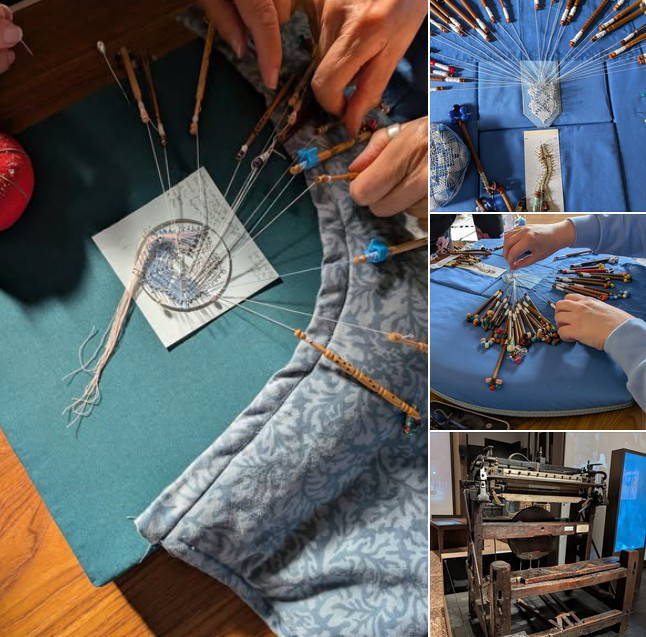
Following on from a detailed review of this history of lacemaking and adaptation, the group then moved across to Nottingham Castle Museum, which has benefitted from significant investment to ensure the exhibits within their walls engage with visitors of all ages. A stocking frame machine is on display – looking, as one of the visitors observed, rather like an instrument of torture! This was critical to the net that was used as an interim step between handmade lace and the punch card machine lace, where piece work saw children as young as nine making running stitches that wove intricate, repeating patterns on the stocking net product. On the floor above, there is a display in the lace gallery of garments trimmed with machine lace, as well as two of the most popular machines used for the automated manufacture of lace.
Shortly after this intensive day in Nottingham, the group invited experienced bobbin lacemakers Stamford Lace Makers from Ryhall and St Johns Lace from Manthorpe, Grantham to teach beginners lacemaking. This is bobbin lace, made on a sawdust filled pillow, with a pattern into which pins are stuck to hold the hand-woven lace in place. Beginners of all abilities were able to create a snake trim or bookmark; those who had already mastered this initial form went on and made more intricate patterns. Of the 10 delegates taking part, at least 3 are planning on joining one or other (or both!!!) groups, to get more proficient. The Aveland History Group are hopeful that we have played a small part towards moving bobbin lace making to a less endangered place on the Heritage Crafts list!